
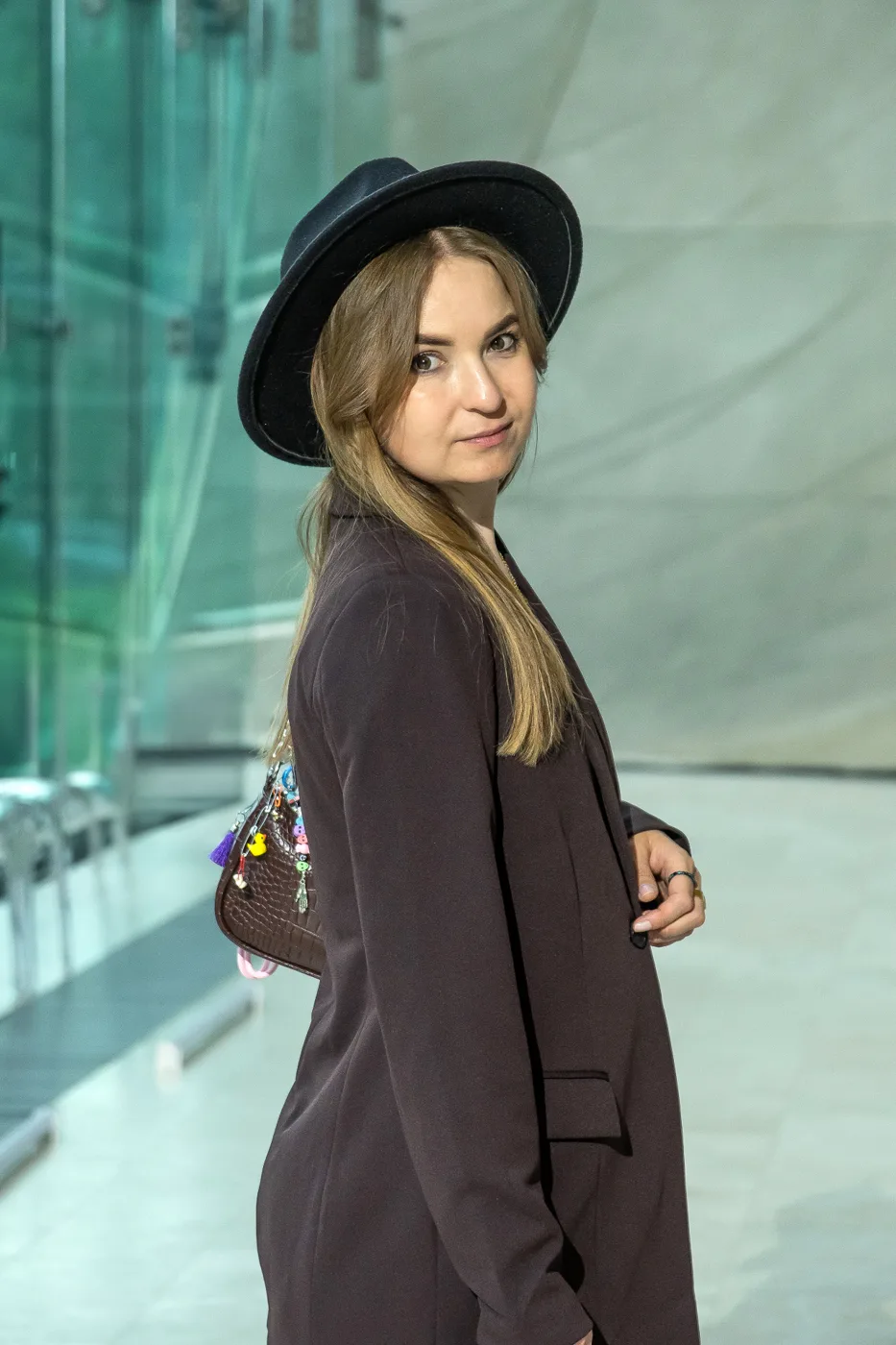
Portrait 005 · POLAND
Marika Kołonowicz
Sculpting with yarn, from her grandmother to the Moon
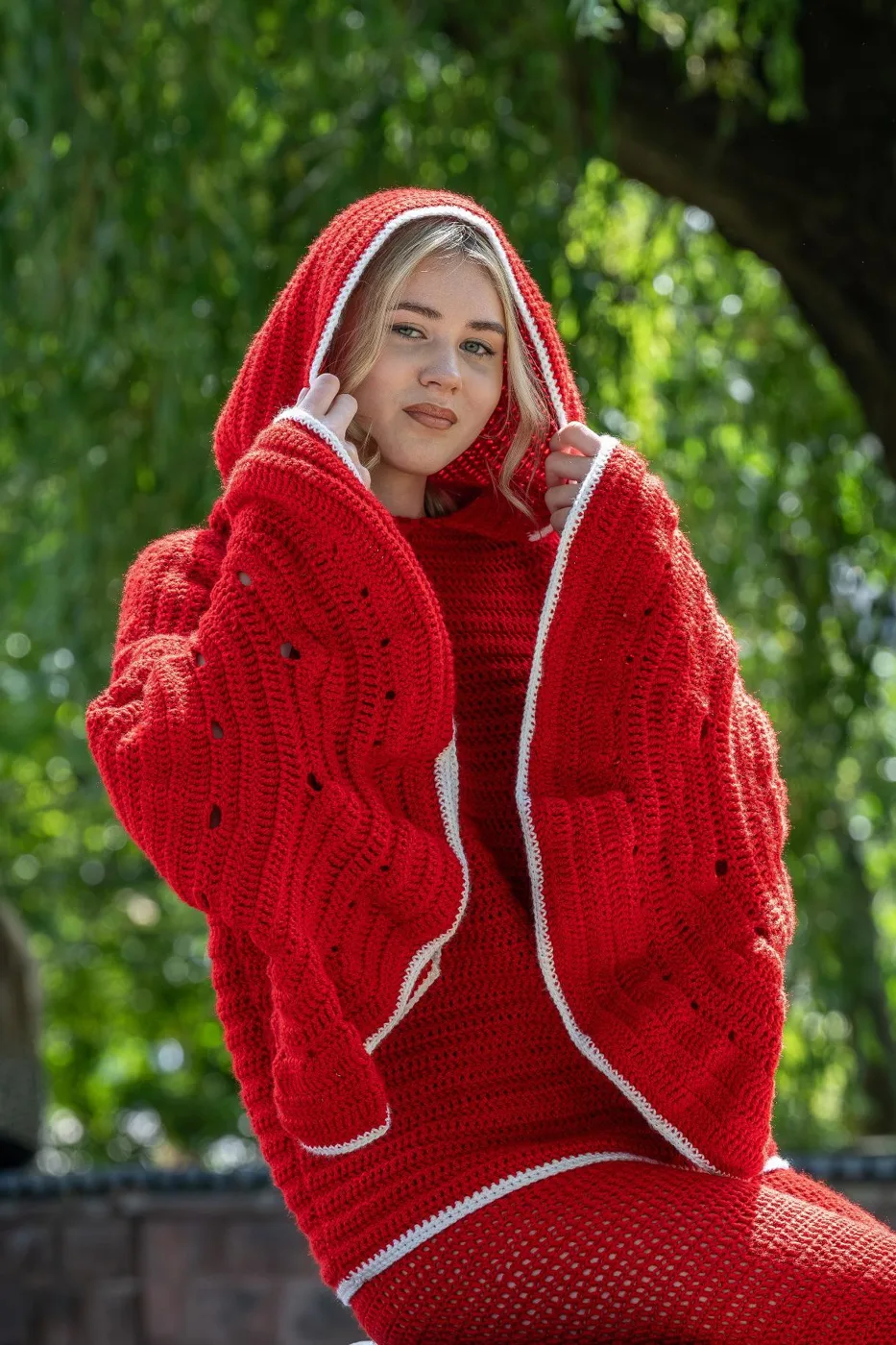
A designer’s daughter, a collection for her late grandmother, recycled denim and a name sent into space with Artemis II.
Introduction by World Crochet Journal
She grew up among sewing machines, patterns and baskets of coloured thread. Today, her sculptural crochet silhouettes walk the runway.
In this fifth portrait of World Crochet Journal, Marika talks about family heritage, upcycling, artificial intelligence as a modern chisel, and the stitch she would send to the Moon.
a garment is not just an off-the-shelf commodity, but a labor of passion and craftsmanship meant to stand the test of time
In her own words · In her own words, in English
You grew up surrounded by fabrics, yarn, and your mother's creations. Is there a particular childhood memory that you feel shaped the artist you've become?
It is hard to point to just one defining moment, as it was really the entire atmosphere of my childhood that laid the foundation and shaped me as an artist. What stuck with me the most, however, were the everyday moments spent watching my mother at work - a designer who created extraordinary pieces throughout the 1970s, 80s, and 90s.
I remember watching in fascination as an ordinary skein of yarn or a simple piece of fabric transformed into something truly unique under her hands. Patterns, sewing machines, baskets overflowing with colorful threads, and our trips together to haberdashery shops were my natural habitat. I also have particularly vivid memories of the time we spent crocheting and knitting together; in our home, needles and hooks weren’t just tools of the trade, but above all, a way to bond and simply be together.
It was those childhood images that taught me humility toward the creative process, patience, and respect for every single detail and seam. That is when I realized that a garment is not just an off-the-shelf commodity, but a labor of passion and craftsmanship meant to stand the test of time - in fact, some of my mother’s pieces from those years have survived in wonderful condition to this day.
Although I eventually developed my own language of expression, those memories continue to resonate within me. While creating the "Janine" collection, dedicated to my late grandmother, I felt as though I was stepping right back into those moments. For me, crochet has become a symbol of gratitude and proof that family heritage can be remarkably powerful, modern, and stylish in today’s world.
Your Janine collection pays tribute to your late grandmother. If she could see your creations today, what would you want to tell her? Is there a detail in the collection that holds a particularly personal meaning?
If my grandmother could see this collection today, first and foremost, I would want to thank her. I would tell her that everything artistic within me grew out of her patience, her warmth, and all those hours we spent crafting together. I would want her to know that her work and passion did not pass away with her - they live on in my designs, taking on a new, contemporary form, and that I am deeply proud of the roots I come from. I think she would smile seeing how techniques once associated with quiet domesticity are now gaining a whole new life and becoming an expression of female strength.
As for a detail with particularly personal meaning, it is the crochet stitch itself, which forms the very heart of this collection. It is not a random pattern, however - I wove into it specific motifs and a rhythm of work that I remembered from watching her hands. In craftsmanship, much like in handwriting, every maker has their own unique "signature," their own tension and way of guiding the thread. Recreating those specific, traditional stitches within modern silhouettes felt like having a conversation with my grandmother all over again. For me, every handcrafted element is a symbol of the closeness, time, and attention she once gave me - something that can never be replicated or rushed by any machine.
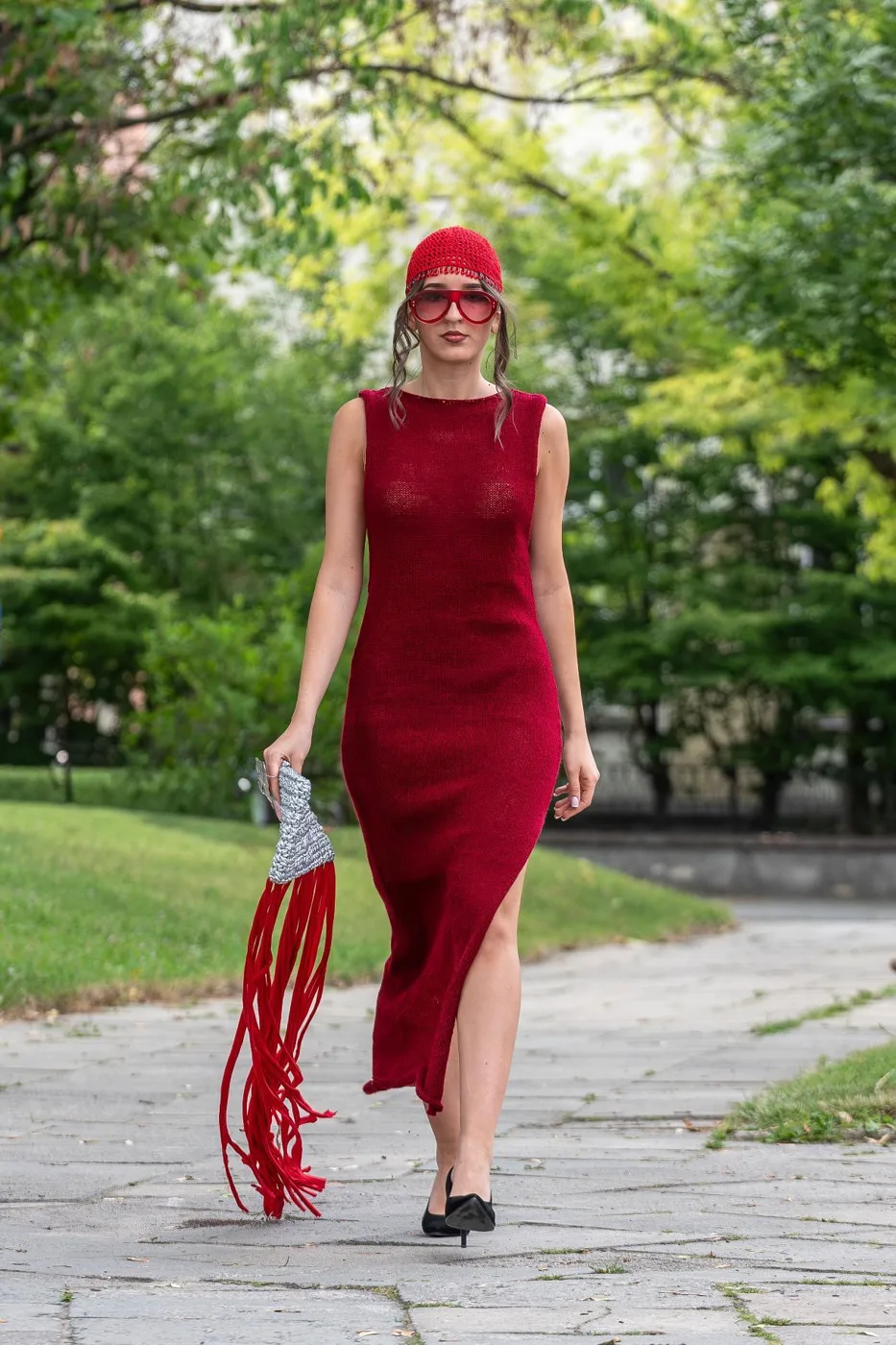
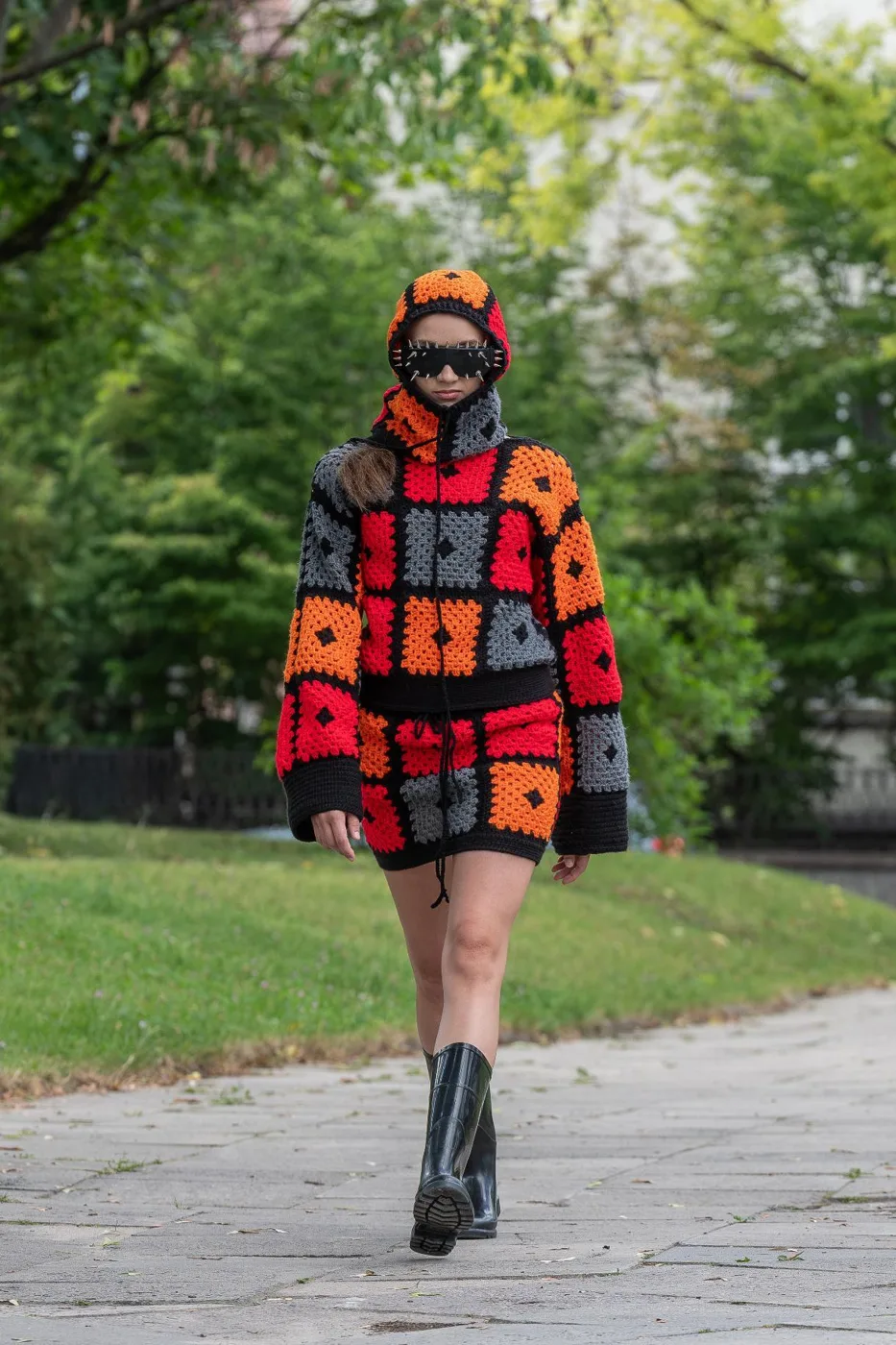
You spent two months creating three crochet silhouettes for OFF Fashion. What was the most challenging moment during that process, and how did you feel when you finally saw your creations presented to an audience?
It was a true test of character and a constant race against time. Hand-crocheting three full looks consumed hundreds of hours of work - thousands of stitches, double crochets, and single crochets that cannot be sped up by any machine. The hardest part of the process was precisely that relentless passage of time, along with having to give up many everyday activities and moments with loved ones just to make sure every last detail was perfected in time.
Despite the overwhelming exhaustion, I never doubted for a second that all the effort was worthwhile. When I finally stood backstage and my designs stepped onto the runway in front of the audience in Kielce, I felt a wave of relief, emotion, and pure pride. Seeing those sculptural forms come to life in motion on the catwalk was the greatest reward for all the sleepless nights. For me, it was proof that traditional craftsmanship - when poured with heart and patience - can hold its own on the international stage and make a truly lasting impression.
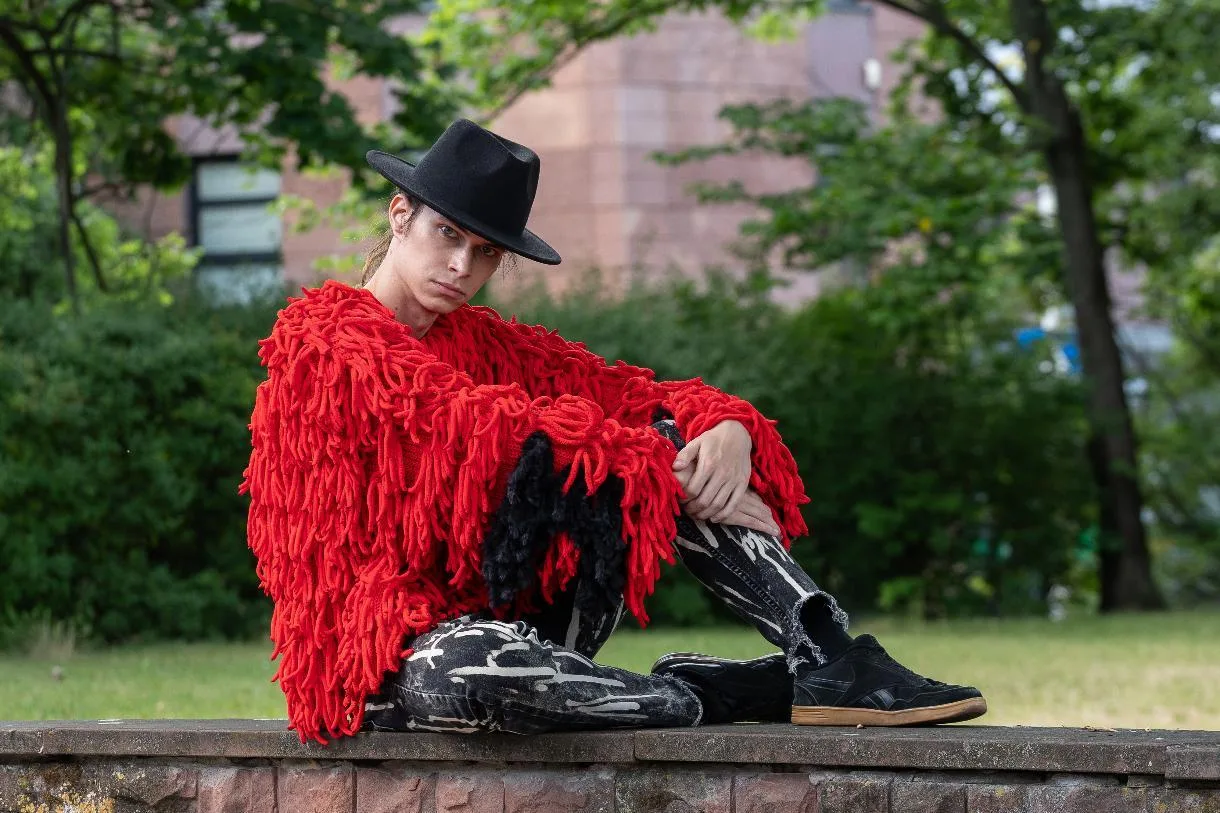
Your work often gives discarded materials a second life. Has a recycled material ever surprised you by becoming something unexpectedly beautiful? What did that experience teach you?
Upcycling clothes is an incredible adventure for me, one where second-hand materials can surprise you at every stage of the process. I vividly remember the moment I discovered the potential of old, seemingly unwanted jeans - both back when I sewed my very first handbag out of them as a teenager, and today, when I turn them into my own signature denim yarn for crocheting. Such fabric already carries its own history, noble distressing, and a unique texture that can never be replicated in a factory. When it transforms into a sculptural stitch, the result can be truly spectacular.
Above all, this experience has taught me mindfulness and a deep respect for what already exists. I realized that what some consider waste becomes a valuable material with a soul in the hands of a creator. Giving things a second life always brings me immense satisfaction and fuels further experimentation - proving that true creativity does not require unlimited resources, but rather an open mind and the courage to look for beauty where no one expects to find it.
true creativity does not require unlimited resources, but rather an open mind
You describe crochet as a way of sculpting with yarn. What can you express through crochet that you couldn't express through painting, photography, or digital art?
Crochet gives me absolute freedom of form and three-dimensionality that no machine or flat surface can replace - not a painter’s canvas, not a camera frame, and not a computer screen. While painting, photography, and digital art operate within the realm of image, yarn allows me to literally sculpt the silhouette in space, build intricate structures, and create completely seamless garments directly from a single skein.
In a world dominated by mass, accelerated production, crocheting is a conscious act of mindfulness for me. I believe in the immense value of time within the creative process - it is precisely those hundreds of hours of work and the touch of the human hand that give designs a soul and a unique texture that can never be replicated or copied.
Moreover, crochet is not a closed chapter from the past for me, but rather the foundation for the most innovative solutions. In my work, I combine it with digital art and artificial intelligence, creating a dialogue between memory and the future. While algorithms open up boundless realms of imagination and allow me to test bold concepts - as in my digital project "Aria Mission – 01" - it is crochet that brings those virtual visions into reality. In my practice, crochet is a manifesto where manual precision and traditional heritage meet the technology of tomorrow.
You combine traditional craftsmanship with artificial intelligence. How do you decide which digital ideas deserve to become real handmade pieces? And do you ever worry that technology might take something away from the human side of creativity?
For me, artificial intelligence is not an autonomous creator, but a kind of modern chisel - a technological partner that supports and expands the boundaries of my imagination. As a rule, I have a clear vision of how a project should look right from the start, and algorithms help me refine it. Through repeated iterations, I generate dozens of variations of intricate structures and unexpected geometries that would be extraordinarily difficult to sketch out by hand, and then I put them through a rigorous selection process.
Whether a digital concept deserves to be brought into reality is decided by my artistic intuition and a certain "spark of life." I look for forms with an organic quality - in fact, I sometimes choose fragments where the algorithm "made a mistake" in a beautiful, unexpected way. If a virtual silhouette carries that unique energy, I treat recreating it almost one-to-one in crochet as a fascinating craftsmanship challenge.
I am not afraid that technology will strip my work of its human dimension, because I know exactly where the line between tool and human lies. AI can suggest a surprising solution, but it will never replace sensitivity, emotion, and the physical touch of the hand. Handcraft rests on a beautiful paradox - despite immense technological progress, a crochet stitch still remains unattainable for machines and requires direct human involvement. In my process, the algorithm opens the door to new realms, but it is only the hundreds of hours spent working with yarn that give a project its true soul and authenticity.
The name of your Aria Mission – 01 collection became part of NASA's Artemis II Send Your Name campaign. What does this connection to space mean to you personally? And if you could send one handmade crochet creation to the Moon, what would it be?
When creating the "Aria Mission – 01" collection, I wanted from the very beginning for it to go beyond the boundaries of how fashion is traditionally perceived and become part of something truly spectacular. Submitting its name to NASA’s Artemis II Send Your Name campaign was a spontaneous moment that turned into one of the most moving experiences of my career. Knowing that a project born from my passion for yarn, color, and craftsmanship flew aboard the Orion spacecraft toward the Moon is an extraordinarily symbolic connection for me. It is proof that artistic sensitivity and traditional heritage know no bounds - they can boldly go hand in hand with the most advanced technology of tomorrow and literally reach for the stars.
If, on the other hand, I could send a physical, handmade object to the Moon, it would undoubtedly be a miniature granny square. For me, it is the absolute quintessence of crochet - a symbol of yarn itself, the very first stitch, and my entire lifelong journey with needlework. Encoded within such an unassuming, classic element is the memory of generations, the warmth of home, and the patience of human hands. Sending it into space would be a beautiful, tender gesture - leaving behind a small, tangible trace of human closeness and artisanal tradition in the vast expanse of the universe.
Imagine someone discovering one of your creations fifty years from now, without knowing who you were. What would you hope that piece tells them about you, your values, and the world you lived in?
I would like this piece to be a quiet manifesto for that person - a testament to times when, against all odds, it was worth slowing down. We live in a world dominated by haste and disposability, yet I believe that the true luxury of the future rests on authenticity, a deep awareness of the creative process, and respect for material. It is important to me that needlework becomes a true force - carrying with it not only the preservation of tradition, but also the philosophy of slow fashion, an absence of rush, inner peace, and profound comfort.
When someone looks at my work fifty years from now, I would want them to see enduring art with a soul that stood the test of fleeting trends. I hope that anyone encountering the MariKoDESIGN.pl brand feels that behind it stands a wonderful history of Polish craftsmanship, as well as extraordinary perseverance, consistency, and determination in pursuing a goal. I would like this project to serve as a reminder that even in the most technologically advanced era, nothing is more precious than the patient touch of human hands and the courage to walk one's own path.
One last question, a World Crochet Map tradition! If you could take your crochet hook anywhere in the world and spend a day creating, where would you go, and who would you love to share that moment with?
Without hesitation, I would take my crochet hook to New York. That city has always fascinated me with its incredible energy, pulsating rhythm, and the boldness with which it brings different worlds together. I can picture a day spent with yarn in one of its cafés - with a cup of my favorite coffee in hand, right in the heart of the world’s fashion capital, where the rush of the metropolis collides with the calm and mindfulness of handcraft.
In such an atmosphere, I would love to create a truly extraordinary piece - more spectacular and refined than anything I have made so far. For me, it would be a symbolic culmination of years of hard work, perseverance, and consistently forging my own path. And who would I want to share that moment with? I think I’ll keep that secret to myself.